Secondhand Smoke and Thirdhand Smoke: Basic Concepts and Scope of Impact
On a rainy evening in November 2023, I was looking after a friend's empty apartment for two days on the 7th floor of an old residential compound in Shanghai. The moment the key turned, my nose judged before my eyes: there was no sign of anyone smoking inside, the ashtray was empty, the balcony was closed, yet the air felt covered by a yellowing film. I threw open all the windows, bought two bags of activated carbon and a bottle of white vinegar, and fiddled with the "three-piece smoke-removal kit" I'd seen online until one in the morning. The next morning, one shake of the curtains and that stale sweet-bitter smell came right back. My friend later admitted: the previous tenant smoked a pack a day in the living room and had only moved out three months earlier.
After that, I deleted the phrase "if the smoke is gone, it's no big deal" from my mind. Secondhand smoke and thirdhand smoke are not two trendy terms but two stages of the same pollution chain: one is still drifting in the air, the other has already been written into the wall paint, the sofa, and your child's rug.
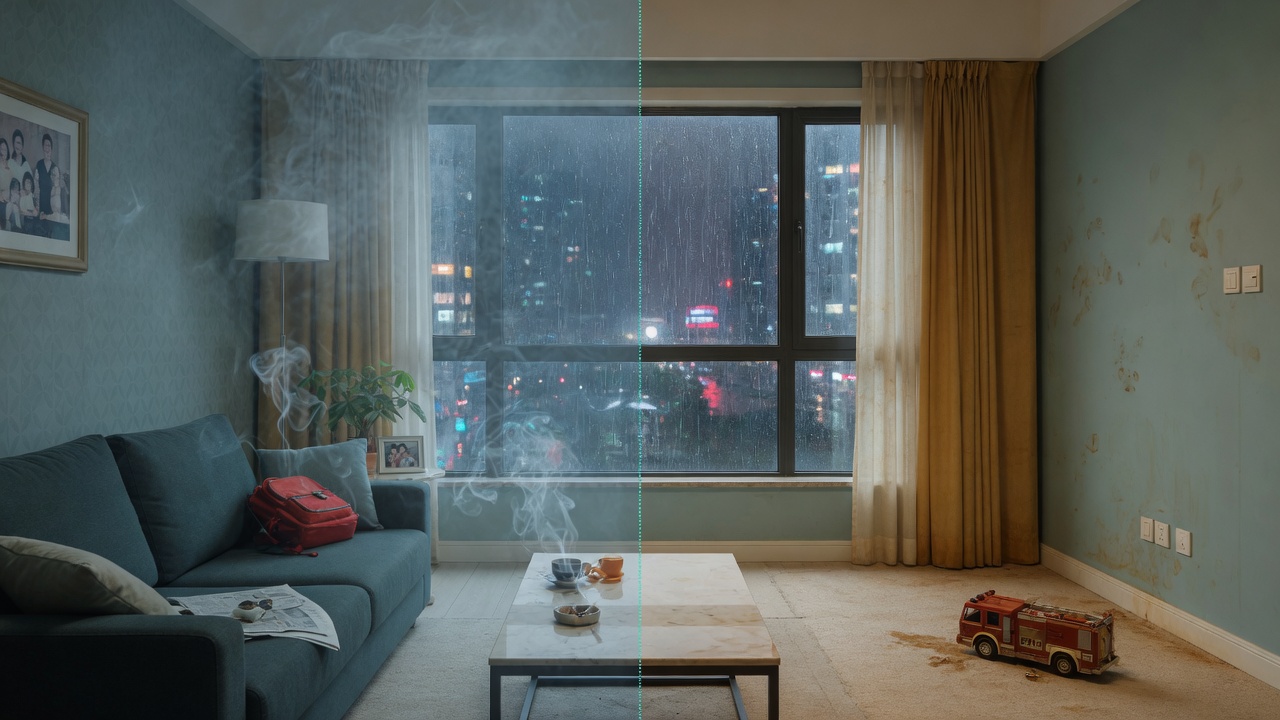
I. Secondhand Smoke: The Part You Can See and Can Avoid
Secondhand smoke, often written in English as Secondhand Smoke (SHS), is also called Environmental Tobacco Smoke (ETS). It is not simply "the air someone else exhales"; it is a mixture of two streams of smoke:
- Sidestream smoke: the smoke released directly from the burning end of the cigarette into the air, at a relatively lower temperature, where the concentration of many harmful substances is actually higher.
- Mainstream smoke: the smoke the smoker draws into the mouth and then exhales.
A common statement in public science materials is that thousands of chemical substances can be detected in tobacco smoke, about seventy of which are known carcinogens; heavy metals, tobacco-specific nitrosamines, and polycyclic aromatic hydrocarbons are all on the list. The World Health Organization has repeatedly stated this firmly: there is no safe threshold for exposure to secondhand smoke — it is not "a little less is fine," but "any exposure carries risk." On the same basis, the number of non-smokers who die prematurely each year worldwide due to secondhand smoke is in the millions (public data from institutions often cite the order of magnitude of "more than 1.6 million").
The scope of impact of secondhand smoke, I am used to noting along four axes:
1. Spatial axis
Enclosed or semi-enclosed spaces are amplifiers: the family living room, a closed balcony, a private car, an elevator, a windowless office, a card-and-chess room, a smoking corner in an underground garage. The car is especially ruthless — the cabin volume is small, and even opening the window can hardly bring the concentration to background levels within minutes. Stairwells and building entrances are sneakier: you "didn't smoke at home," but neighbors may still catch a wisp through shared ventilation shafts and door gaps.
2. Temporal axis
From the moment someone smokes to several hours afterward, the particulate matter and gaseous components in the air may still remain above background levels. Opening windows and ventilating can push the concentration down, but pushing it down is not the same as "returning to zero"; it only flattens the peak.
3. Population axis
Children, pregnant women, the elderly, people with asthma/COPD, and people with cardiovascular disease are often more vulnerable at the same exposure level. Infants and toddlers breathe at a higher rate and move close to the ground, so in the same room they effectively stand in a more polluted layer.
4. Exposure pathway
It is mainly inhalation. Stinging eyes, a tight throat, and coughing are the immediate sensations many people feel; in the long term it is linked to coronary heart disease, lung cancer, and respiratory diseases — these are contents repeatedly written into fact sheets by public health institutions, not internet jokes.
I have a very makeshift controlled experiment of my own. During the Spring Festival in 2024, I went back to a county town in Hubei; relatives were playing mahjong in the living room, three people taking turns lighting up, the window cracked open a sliver. I placed a simple PM sensor on my phone (consumer-grade, only good for trends) on the tea table: within half an hour of starting, the reading climbed a big chunk from the outdoor background level I had brought back; when I retreated into the inner room and closed the door, the reading dropped immediately, and bounced back when I opened the door again. The numbers themselves were not precise, but they made tangible the matter of "being able to avoid it": the main battlefield of secondhand smoke is the air, and distance and partitions really do work — provided you have the right to leave.
Many people do not have this right. Renting and sharing housing, a boss smoking in the office corridor, an elderly person convinced that "smoking on the balcony doesn't count as harming the family" — these are the real radius of influence of secondhand smoke: it follows power structures and living habits, not just the cigarette tip.
II. Thirdhand Smoke: The Smoke Is Gone, the Bill Is Not Sett
Thirdhand smoke, Thirdhand Smoke (THS), refers to tobacco-related pollutants that remain on object surfaces, in dust, and in fabric fibers after smoking, as well as the substances they subsequently release and react to form. Mayo Clinic, U.S. FDA science materials, and the science pages of domestic CDCs and local health commissions are highly consistent: clothing, furniture, carpets, curtains, walls, car interiors, and even hair and skin can all carry these residues; the time scale can be days, weeks, or even months.
Its essential difference from secondhand smoke lies in:
| Dimension | Secondhand Smoke | Thirdhand Smoke |
|---|---|---|
| Form | Smoke and particles in the air | Surface residue, dust, re-volatilized gases |
| Can it be noticed at a glance | Often visible and smellable | Often "smells stale, no visible smoke" |
| Main exposure pathway | Inhalation | Inhalation + skin + hand-to-mouth ingestion |
| Temporal character | On the spot to several hours | Can accumulate, can persist |
| Typical misconception | "It's fine once it disperses" | "No one smoking means no smoke" |
More troublesome is the "second act" at the chemical level. Residual nicotine can react with nitrogen-oxide-related components common indoors to form carcinogenic tobacco-specific nitrosamines (TSNAs) — research literature and science translations all point to this: thirdhand smoke is not a static stain; it will continue to "grow poison" on the wall. Thirdhand smoke resource centers in places like California simply call it tobacco smoke residue: a chemical debt embedded deep in carpets, building materials, and sofas.
The scope of impact of thirdhand smoke is often larger than the parties imagine:
1. Space: across rooms, across leases, across vehicles
What I learned in that old apartment in 2023 was: no one had smoked in the master bedroom, yet the wardrobe still smelled — the return air of the central air conditioning and the airflow through door gaps would relocate the pollutants. Secondhand houses, long-term rental units of smokers, and the back seats of ride-hailing cars are all high-incidence scenarios. What you buy as "fine-decoration delivery" does not equal "chemically clean."
2. Time: a tail measured in months
Opening the window for one day cannot solve embedded residue. For my friend's apartment, we did these operations:
- Wet-wiped all hard surfaces twice with a neutral detergent;
- Sent fabric curtains for dry cleaning and washed the sofa covers;
- Vacuumed the floor and then wet-mopped it, cleaning the edges and corners with an old toothbrush;
- Opened the windows for more than two hours every morning and evening for three consecutive days;
- Portioned activated carbon into bowls and placed them along the baseboards and under the sofa.
The result: the pungent "fresh smoke smell" receded, but when it turned damp on rainy days, the "stale smoke sweet-bitter" smell would still rise from near the baseboards. My later judgment was realistic — household cleaning can reduce the load, but can hardly return it to zero; true zeroing usually requires replacing high-adsorption materials (carpets, mattresses, air conditioning filters), with costs jumping straight from hundreds to tens of thousands of yuan.
3. Population: children are the "super-exposers" of thirdhand smoke
The relevant science materials from the Chinese CDC put it plainly: children crawling on the floor and putting things in their mouths are actively collecting surface residue. Adults mainly rely on breathing; toddlers add a hand-to-mouth pathway, and their skin contact area relative to body weight is also larger. What you think of as "I'll smoke again after the child falls asleep" or "I'll put on a jacket, smoke outside, and then hold the child" may halve the risk in secondhand-smoke logic, but in thirdhand-smoke logic the jacket, the beard, and the gaps between the fingers remain carriers.
4. Pathway: three invisible entry points
- Breathing: re-volatilization of residue, re-suspension of dust;
- Skin: leaning on the sofa, playing on the carpet, being held by a smoker;
- Ingestion: sucking fingers, chewing toys, picking up food dropped on the floor.
In 2022 I stayed overnight at a friend's home in Hangzhou; he claimed to "only smoke on the balcony." The next morning, his two-year-old daughter put the toy car by the balcony threshold into her mouth. Looking at that car I thought: most of the sidestream smoke from last night had indeed been blown away by the wind, but who measured that film on the plastic surface of the threshold that felt astringent to the touch?
III. How Large Is the Scope of Impact: A Map at Life Scale
Bringing the concept down to "whether I can actually avoid it."
The home
This is where secondhand smoke and thirdhand smoke overlap most heavily. When one person smokes in the bathroom, the exhaust fan often just sends the smoke into the ducts and the gaps between apartments; when one person smokes on the balcony, return air and clothing still bring thirdhand smoke into the master bedroom. The so-called "smoke-free home" is not "no ashtray in the living room," but: no tobacco is burned within the building envelope of the residence, nor is a large amount of smoke residue brought in.
Vehicles
A private car is a concentrated reactor: the seat fabric, the child safety seat, and the seat belts are all sponges. In 2021 I bought a nearly-new used car; the seller said "good condition, the owner doesn't smoke." After two weeks, once the air conditioning was turned on after sun exposure, the back seat still had that cloying tobacco sweetness. Later, when the air conditioning filter was opened, the edge of the filter element was yellowed — this is evidence written by thirdhand smoke in materials.
Public and semi-public spaces
Elevators, stairwells, open-plan office pantry areas, the upwind side of the smoking zone outside a hospital. Secondhand smoke appears in a "pulsing" pattern in these places; thirdhand smoke settles on handrails, seats, and carpets. You cannot demand that an entire city return to zero, but you can recognize which environments count as "high residue."
Generational, across the time span
The harm of secondhand smoke can be an asthma attack after a single gathering, or chronic exposure after years of cohabitation. Thirdhand smoke, on the other hand, may continue to act on the next family's child after the smoker has moved out. The scope of impact is therefore not only "those present," but also "those who come after."
On a global scale, secondhand smoke exposure remains a problem for a huge population: one study estimates that in 2021 the number of people exposed to secondhand smoke worldwide was in the billions. Public-place tobacco control in China is progressing, but the home and private vehicles remain the weak spots — and thirdhand smoke falls almost entirely within "private order," where the law cannot reach, and only awareness and household rules can act.
IV. Three Self-Justifications I've Seen, and Why They Don't Hold Up
"I open the window for half an hour after I finish smoking."
It helps with the peak of secondhand smoke, but for thirdhand smoke that has already sunk into the sofa it is almost a placebo. Half an hour of ventilation cannot wash away the nicotine film in the fabric.
"I never smoke in front of the children."
No plume of smoke in front of them does not mean the jacket, the sofa, or the car seat is clean. Thirdhand smoke does not need to "perform for the child to see."
"If you can't smell the smoke, it means there's no problem."
The sense of smell fatigues, and low-concentration residue may not be pungent, yet it can still enter the respiratory tract via dust. Taste and smell are a crude dashboard, not a laboratory.
My view is clear: defining "smoke-free" as "no smoke visible in the current air" is the most expensive laziness of the adult world. A truly actionable smoke-free environment must control at least three things at once — no burning on the spot, cleaning before contact with infants and toddlers after leaving the pollution source, and not treating highly polluted secondhand spaces (a smoker's car, a heavy-smoke rental unit) as a long-term habitat for children.
V. Once the Concepts Are Clear, the Boundary Can Be Drawn
If I were to remember just two sentences, I would suggest these two:
- Secondhand smoke is the air pollution you are forced to share when others smoke; its core is "exposure happening right now," and its scope of impact is determined by the degree of enclosure, distance, duration, and ventilation.
- Thirdhand smoke is the chemical residue that remains in the environment after smoking ends; its core is "pollution already written," and its scope of impact is determined by material adsorption, the degree of cleaning, children's behavior, and residential history.
The two are not either-or. In most family-smoker scenarios, they are a serial drama: first comes secondhand smoke, which then settles into thirdhand smoke; opening the window cuts off the previous episode but does not automatically delete the next one.
While writing this, I thought again of that old Shanghai apartment. My friend eventually broke the lease early; the agency deducted part of the cleaning fee, with the reason written very officially: "odor exceeds normal use." Those few hundred yuan could not solve the residue in the walls, yet it was unexpectedly honest — the market acknowledges the existence of thirdhand smoke more than many smokers do.
The scope of impact is as large as you want to make it: from the sidestream plume of a single cigarette, to the seat foam of a car, to the crawling radius of the next family's child. Clarifying the concepts is not to frighten people, but to let you know, when you close the window, hold the child, sign the lease, or sit in the passenger seat, exactly what you are choosing.